Teresa Baksa: Middle Years
Provincetown/Landscapes and Figures, 1990-1995
“The dunes are a moving, changing entity that’s alive and wild. From a distance they seem quiet and stark. When you’re out there working, there’s a lot of activity. The wind blows, the weather moves in quickly, the atmosphere changes. It’s intense.”

Teresa was drawn to the lower region of Cape Cod, especially the Provincelands. During quieter seasons, she would travel from Yarmouthport to Provincetown 2-3 days a week for morning life drawing sessions at the Provincetown Art Association and Museum. Afterward, she painted in the dunes, creating small to medium watercolor studies to use as reference for larger studio works in watercolor and pastel.


The Lower Cape landscape feels vast and impressive, bathed in bright light reflecting off the ocean. Some dune shacks and paths dot the area, but there isn’t much human influence. When Teresa would arrive to paint, it would start off quiet. But soon, birds, insects, and other hidden creatures would become aware of her presence and make themselves heard. Painting outdoors allows the artist to connect deeply with nature, experiencing not just sights, but sounds, touch, smells, and the passage of time. The artist becomes part of the landscape, and the landscape is part of the artist.


Teresa frequently painted landscapes from her favorite spot near Herring Cove Beach. Her vertical paintings were influenced by Chinese ink art on vertical scrolls that she studied at Harvard and The Museum of Fine Arts in Boston.

“Teresa, use colors you wouldn’t ordinarily use...”
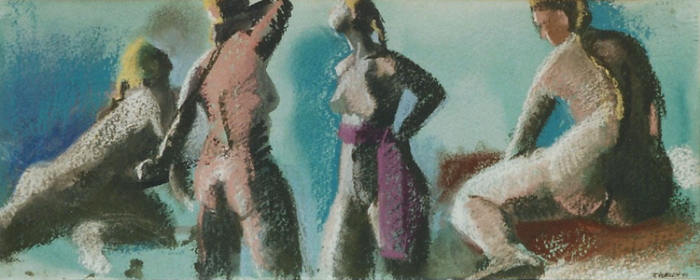
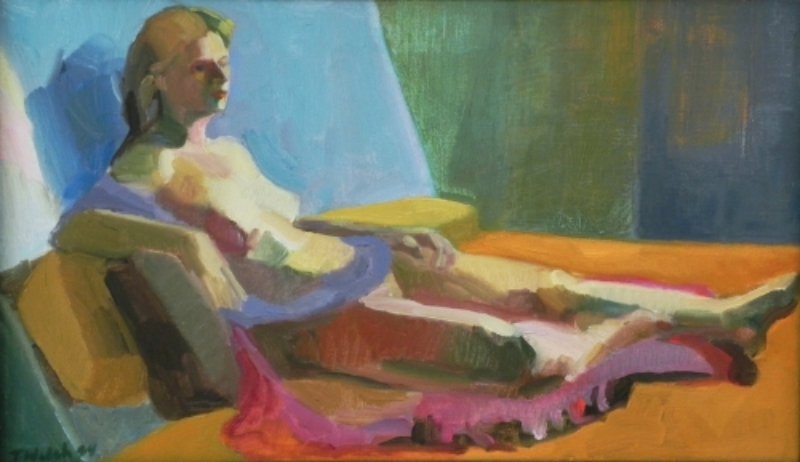
The Provincetown Art Association & Museum (PAAM) in Provincetown, MA, is a historic art center over one hundred years old. It hosts exhibitions, classes, lectures, and performances, and offers drop-in life drawing sessions twice a week for all artists. PAAM has attracted well-known, emerging, and lesser-known artists due to its open membership. From 1991 to 1995, Teresa became devoted to life drawing and painting at PAAM, inspired by the north light from the studio window and the dedication of fellow artists and life models. It was here that she met artist Salvatore Del Deo.

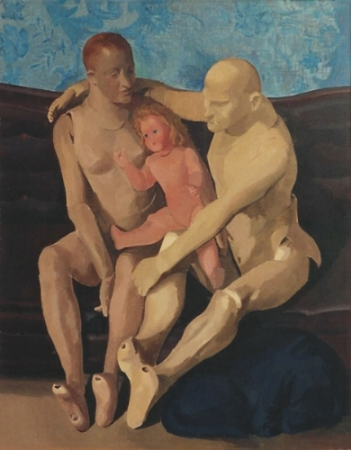
Salvatore Del Deo is a representational artist who has mastered the skills of drawing and painting in a traditional way but through a modern lens. As a young artist, he learned from Provincetown masters like impressionist Henry Hensche, symbolist Edwin Dickinson, and cubist Karl Knaths to name just a few. His painting blends these influences, with the ideas of the abstract expressionist artist Hans Hoffman showing a modern style while reflecting his Italian roots and his love for the great ideas of western civilization. Teresa quickly recognized his talent. During life drawing sessions at PAAM, Salvatore supported younger artists, similar to the renowned painter Pissarro. Teresa took a few classes with him and continued their relationship in weekly sessions, where he became her mentor and friend.
“Teresa, the neck fits into the ribcage like a column....remember to indicate the flat and the round of the muscles...and differentiate the big planes.”

In his work and in his teaching Salvatore always emphasizes painterly form, and he has a "nuts and bolts", no-nonsense approach to teaching this. He is a gutsy painting instructor who is not afraid to grab a paint brush right out of a student's hand, to demonstrate by doing rather than just explaining, if he deems this appropriate for an advanced student. When this happened to Teresa one day in class, she stepped aside from her figure in progress, and marveled at the master's ability to "pump up the form" of her figure painting by exaggerating contrast to show direction of planes, better indicating bony protrusions, and using directional brushstrokes to accentuate the volume of the forms. By demonstrating in this way, Salvatore could illustrate the importance of painting not just what one sees, but also what one knows.
The collaboration painted in class by Teresa Welch and Salvatore Del Deo is shown below:

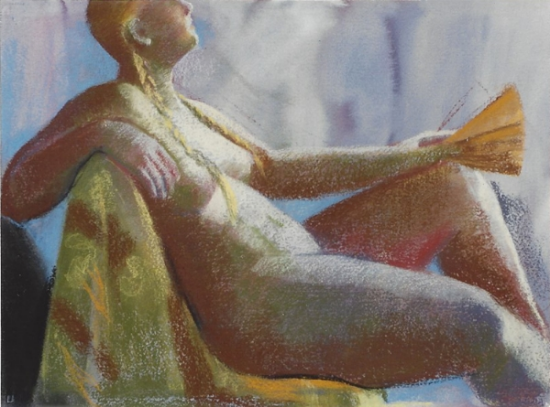
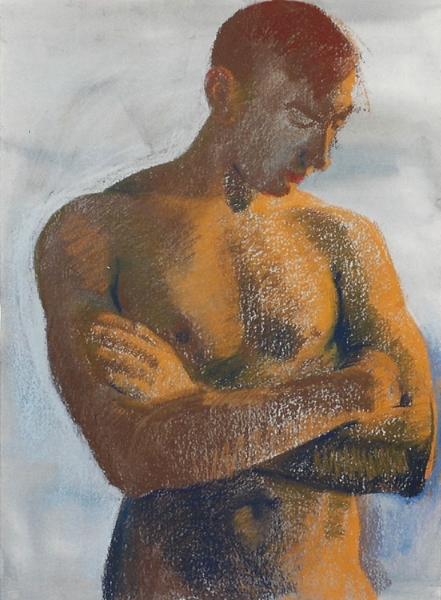
Some other figures painted in the PAAM studio:


Artistic Recognition
In 1993, Teresa entered a painting in a self-portrait exhibition at PAAM, which was seen by gallerist Ann Start of Archipelago Gallery, in Wellfleet. After seeing that painting she gave Teresa her first gallery exhibition on Cape Cod that summer. During that same time period Teresa was approached by writer Claire Golding who asked if she could write an article about her art for Cape Cod Publishing Company's Antiques & Arts, the monthly magazine supplement to its newspapers The Register, and The Cape Codder.


Click here to read Antiques & Arts article.
Partners In Art
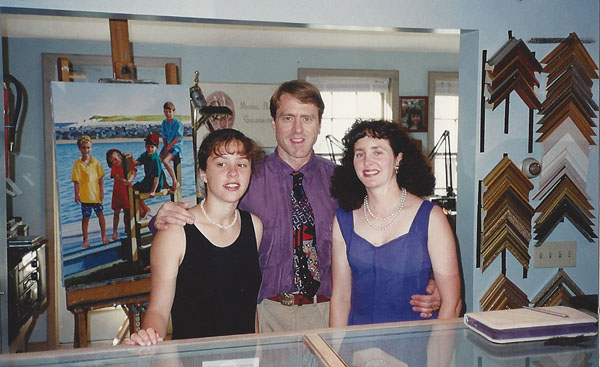
On November 5, 1995, Teresa married Michael Baksa, a Goldsmith who operated a jewelry studio/gallery on Route 6A in Dennis, MA. where he created and showcased his own work. The couple combined their studios into one business at Michael's location in Dennis, and it became Baksa Studio, Goldsmith & Artist.

For the next 20 years Teresa and Michael created their art and showcased it at Baksa Studio. The Studio/Gallery was situated in picturesque Dennis Village, an area that is brimming with artistic activity. Dennis Village is home to Cape Cod Center for the Arts, a campus that includes the historic Cape Cod Playhouse, Cape Cod Cinema, and Cape Cod Museum of Art. Over the years the Baksas participated in the many art-related village events which included evening gallery walks and openings, regional art festivals, and Christmas Strolls. Teresa painted in a small studio in the back, off of Michael's workshop, and the artists split the front gallery space. Baksa Studio was one of many artist studio/galleries in operation on the Cape that offered to those people who sought a personal experience in buying art from its source, a chance to participate in dialogue with the creators. Simultaneously it provided the artists with insight from viewers and purchasers, which in most cases, resulted in an enriched experience for the artists.
In 1995, when Teresa was first married, the new domestic life she was living influenced her work. With Michael, came his beautiful young daughter Erin who became a delightful step-daughter, friend, and artist's model.


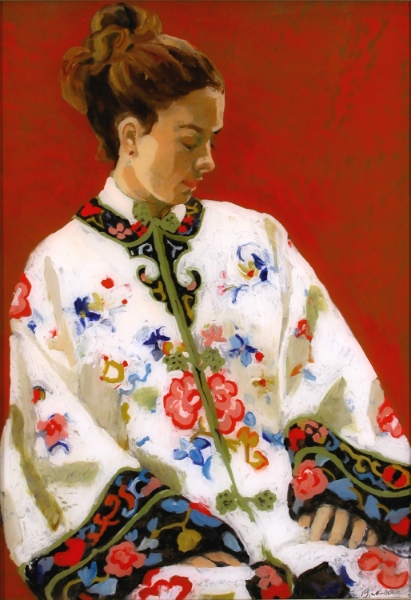
Other family members also became inspirations...
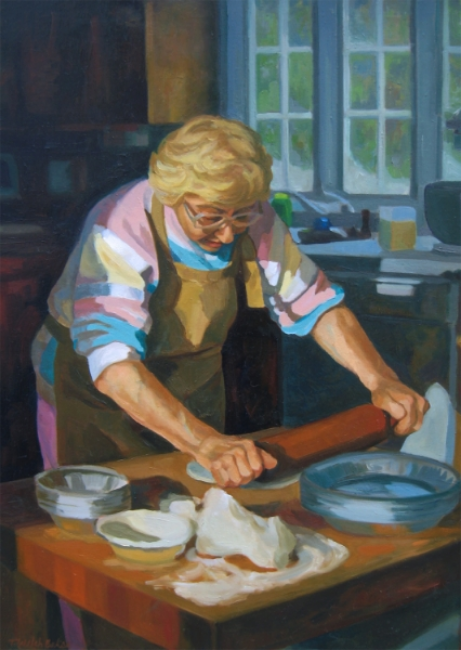

...as did Michael's collection of antiques, and especially his Japanese Teapot.
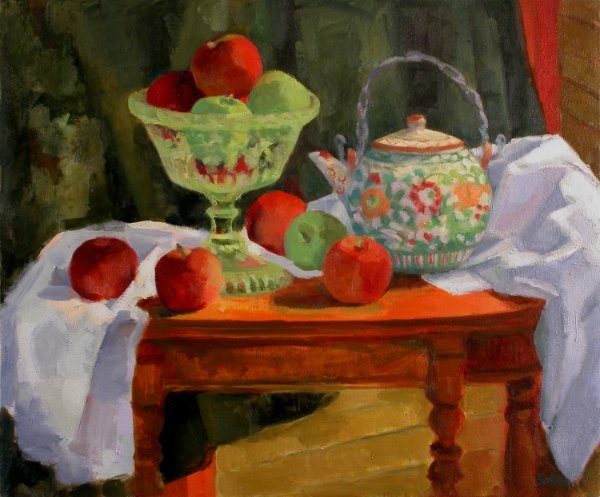
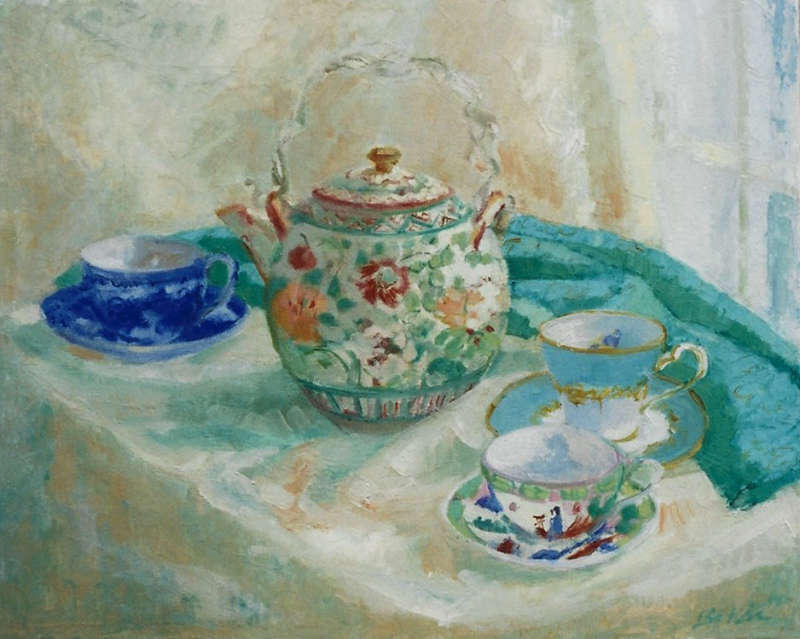
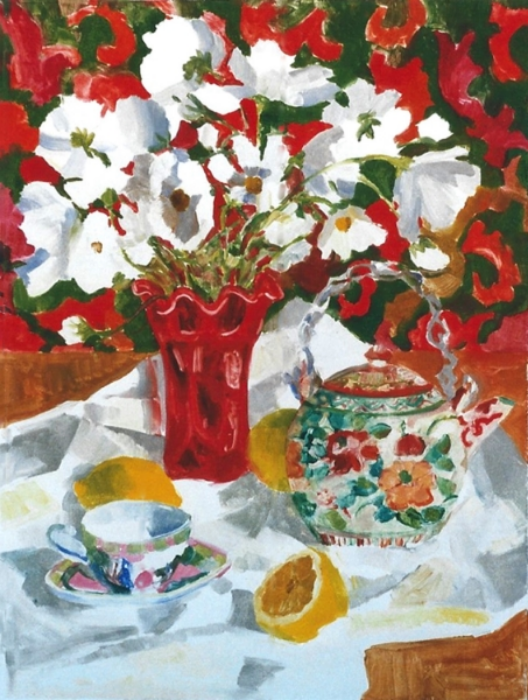
Teresa's oil still life's expanded into the print medium of oil monotypes on paper. She enjoyed the spontaneous effects created by painting with oils on a plexiglass plate and then applying a sheet of dampened rag paper, with pressure, to the plate. Before the print was "pulled", some paint might be removed from the plate with assorted tools by "drawing" into the paint. This left white lines or areas on the print that created highlights, description, and definition. There was always an element of surprise in the reverse image of the pulled print. Teresa created a large series of monotype prints, and during the summer of 2000, and 2001, she taught the technique to children as part of the Explorers of The Art World summer workshop series at Cape Cod Museum of Art.
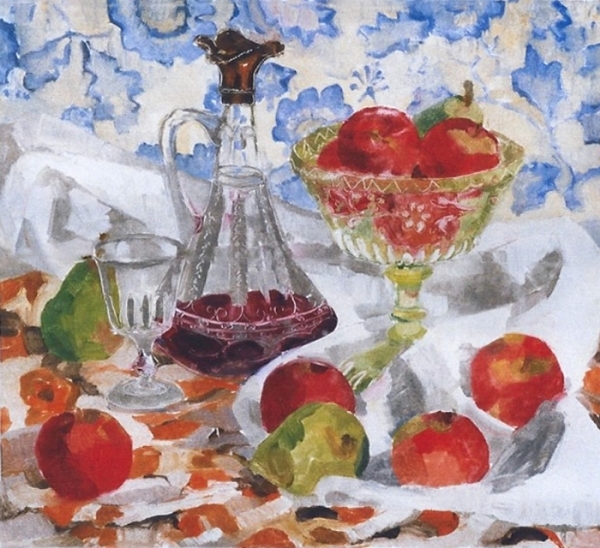


Summers at Baksa Studio were busy with customers and so Teresa often worked in watercolors because she could quickly wash the paint from her hands on the way to the gallery in front, to wait on people, when the door bell signaled customers had entered the gallery. Additionally, with the abundance of beautiful flowers all summer, Teresa could not resist creating watercolor floral paintings, which had been a reliable genre since Teresa's years in Yarmouth Port, to generate much-needed painting sales.


Continue to Middle Years Continued